


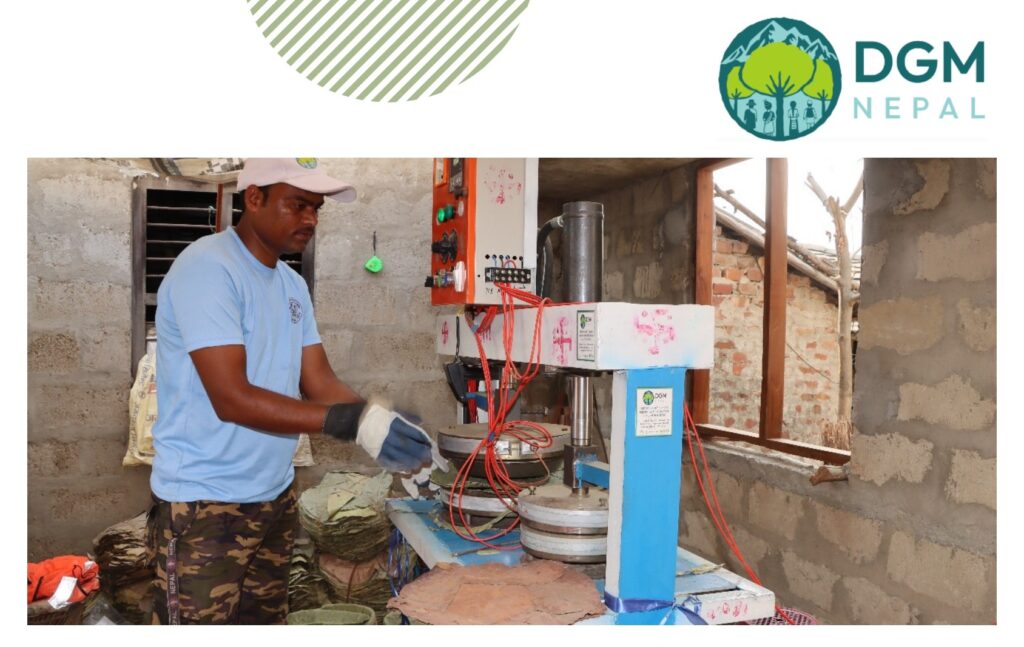
Coming from the marginalized Dalit community of Madhesh Province, 34-year old Rajeswor Chamar faced several socio-economic barriers, including landlessness, low wages, and a lack of employment opportunities. His family, like many others, traditionally depended on agriculture for livelihood and the forest for fuelwood. The economic challenges had pushed him to the edge of seeking foreign employment in the Gulf countries—an all-too-common path for young men in the country hoping fora better future.
However, everything changed when he learned about the DGM Nepal project’s small grant through a friend. Inspired by his mother, who used to make handmade leaf plates for traditional occasions, Rajeswor envisioned transforming this age-old practice into a sustainable business. “My mother usedto make leaf plates by hand. I got inspired watching her and thought – why not do it in a better way? ”he shared. He applied for the grant and initiated a forest-based small enterprise named “Janaki DunaTapari Udhyog” with an objective to transform the traditional skill of handmade leaf plate production into a sustainable source of livelihood for himself and marginalized Dalit women in his community, while also promoting sustainable forest management through the sustainable use of leaf resources from nearby forests.
The DGM Nepal grant helped him to buy a leaf plate-making machine, received training in its operation, and entrepreneurship development guidance. Before the grant, he produced only about 40 plates a day, earning around NPR 5,000 monthly and selling only within the community. After acquiring the machine, production increased to 600 plates per day, a fifteen fold boost and his monthly profit rose to NPR 35,000. Now, leaf plate production after using the machine has fetched NPR 2 to 3 each – before it was only 50 paisa,” he explained. The improved efficiency and quality of the products opened doors to wider markets and better profits.
Beyond his personal success, Rajeswor’s initiative brought positive change to his community. He trained 20 Dalit women and currently employs 10 of them. “People in my community are happy to get jobs and learn new skills,” he said with pride. Altogether, 14 individuals work with him today, including 12 Dalits and 2 others. A standout impact of the grant has been the employment and empowerment of Dalit women. This initiative has given many women in his community their first experience of stable income, skill-building, and self-confidence and contribute to their households. The impact has gone beyond just employment—it has brought social recognition, confidence, and improved education for their children.
Rajeswor is committed to growing his enterprise further. He is exploring packaging technology to increase the shelf-life and freshness of the plates and expand to larger markets. Reflecting on his journey, he believes that the DGM Nepal grant not only alleviated his financial stress —it gave him
a reason to stay, grow, and uplift others along with him. His initiative not only preserved a traditional practice but also created a model for inclusive, local, forest-based enterprise for sustainable development—a core vision of DGM Nepal.
